Riot. Strike. Riot by Joshua Clover
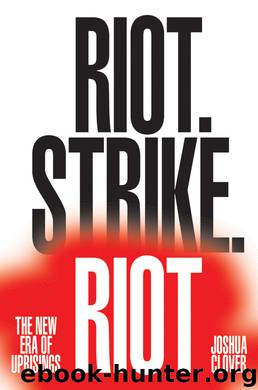
Author:Joshua Clover
Language: eng
Format: epub
Publisher: Verso Books
He is no proponent of labor struggles, however. His question is how to pass through the riot to more effective combat, and toward this he calls for the “Vanguard Party”—that is to say, toward kinds of order and discipline inherited from the organizing of proletarian labor and agricultural peasantry. It is characteristic of the period that both riot and strike, seeking to overleap their own limits, proceed alongside each other. Each seems to require the other to appear as revolutionary.
This concurrence cannot be recognized as such by official observers. The Kerner Report, using the rubric of “disorders,” offers this description of the Great Rebellion: “A spirit of carefree nihilism was taking hold. To riot and destroy appeared more and more to become ends in themselves. Late Sunday afternoon it appeared to one observer that the young people were ‘dancing amidst the flames.’”19
This cannot but harmonize with the “infernos” of labor described above. Everything is burning. Alongside the large-scale increase in black labor, black unemployment after World War II hovers between 150 and 400 percent higher than white, and significantly above nonwhite Hispanic as well.20 Detroit’s overall population peaks in 1950 and begins a fairly steep decline; the city ceases to grow economically around 1960, even as the demographic shift continues.21 The racial burden of deindustrialization is further freighted by the “last hired, first fired” union policies which reverse the second Great Migration in an ongoing Great Exclusion. Thus we see two trends: a still-dominant manufacturing economy internalizing black labor, but beginning its decline and unable to absorb in full the demographic influx. This implies an increase in both employed and surplus black populations, subject to differential dispossessions. But these tendencies are moving in opposite directions. In the period 1965–1973 the trend lines cross like wires sparking and Detroit sees the intensification of conditions for both riot and strike, centered within the black community. This is the situation as the sixties accelerate, and the basis for the political sequence that unfolds, even if it cannot endure.
By 1970, the sequence’s opening has already begun to close:
[The League] believed that the Oakland-based Black Panther Party was moving in the wrong direction by concentrating on organizing lumpen elements of the Black community. The League did not believe that a successful movement could be based upon the lumpen, as they lack a potential source of power. The League believed that Black workers were the most promising base for a successful Black movement because of the potential power derived from ability to disrupt industrial production.22
Download
This site does not store any files on its server. We only index and link to content provided by other sites. Please contact the content providers to delete copyright contents if any and email us, we'll remove relevant links or contents immediately.
| Africa | Americas |
| Arctic & Antarctica | Asia |
| Australia & Oceania | Europe |
| Middle East | Russia |
| United States | World |
| Ancient Civilizations | Military |
| Historical Study & Educational Resources |
Cecilia; Or, Memoirs of an Heiress — Volume 1 by Fanny Burney(32558)
Cecilia; Or, Memoirs of an Heiress — Volume 2 by Fanny Burney(31956)
Cecilia; Or, Memoirs of an Heiress — Volume 3 by Fanny Burney(31940)
The Secret History by Donna Tartt(19082)
Sapiens: A Brief History of Humankind by Yuval Noah Harari(14389)
Leonardo da Vinci by Walter Isaacson(13336)
The Radium Girls by Kate Moore(12026)
Sapiens by Yuval Noah Harari(5369)
How Democracies Die by Steven Levitsky & Daniel Ziblatt(5218)
The Wind in My Hair by Masih Alinejad(5095)
Homo Deus: A Brief History of Tomorrow by Yuval Noah Harari(4918)
Endurance: Shackleton's Incredible Voyage by Alfred Lansing(4780)
Man's Search for Meaning by Viktor Frankl(4604)
The Silk Roads by Peter Frankopan(4532)
Millionaire: The Philanderer, Gambler, and Duelist Who Invented Modern Finance by Janet Gleeson(4478)
The Rape of Nanking by Iris Chang(4211)
Joan of Arc by Mary Gordon(4109)
The Motorcycle Diaries by Ernesto Che Guevara(4098)
Stalin by Stephen Kotkin(3965)
